Everyday Jewellery Essentials for Men (From Minimalist to Statement)
The core jewellery pieces every man should own—chains, rings, bracelets, and more—with sizing and styling basics.
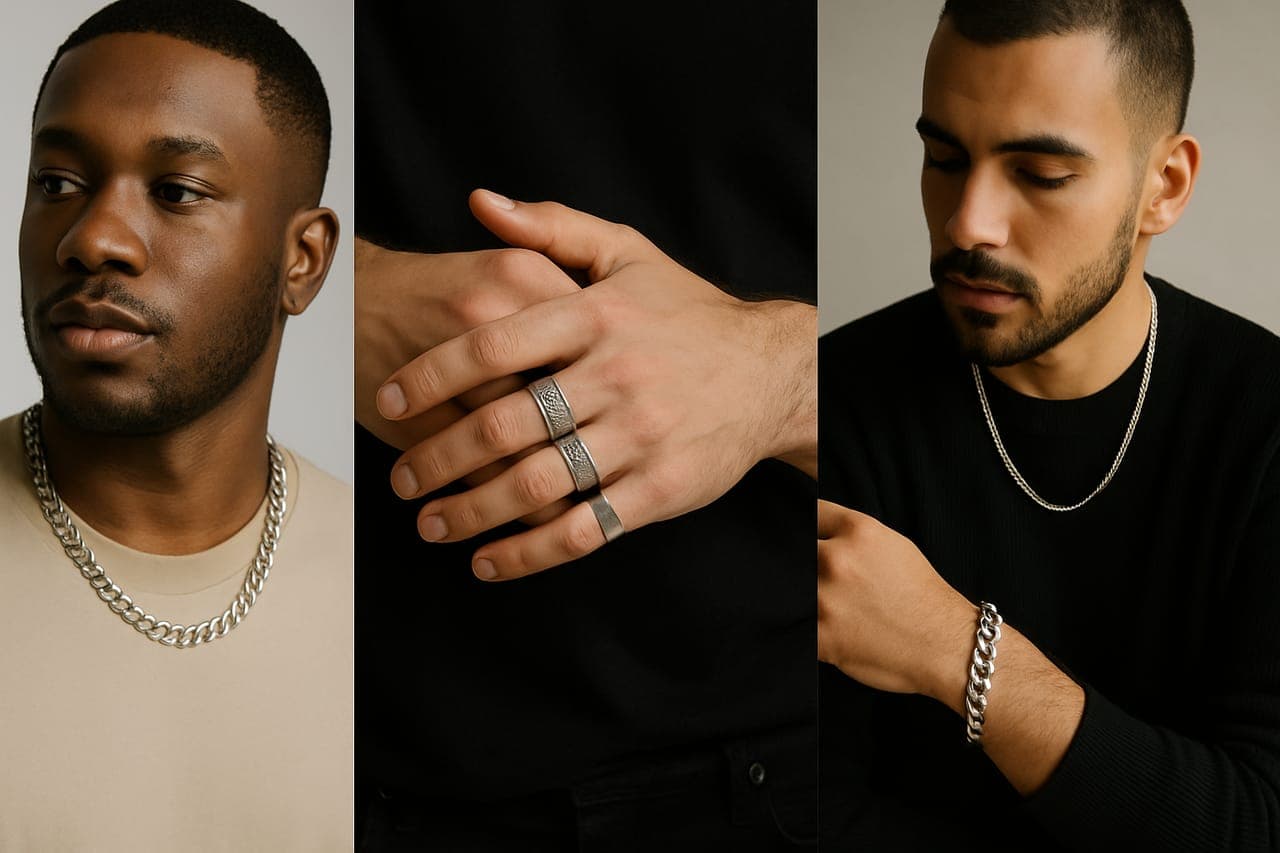
A compact men's jewellery capsule can start with a watch, an everyday chain, one ring, and a bracelet, chosen deliberately and sized for the wearer. A 20–24 inch chain is a useful try-on window rather than a universal default; rings and bracelets need direct measurement. This guide covers that starter kit and the choices that make it coherent.
The men’s jewellery starter kit
Begin with one watch, one everyday chain, one ring, and one bracelet, then expand.
Most guys don’t need a drawer full of pieces. Start with four: a watch, a simple chain, a single ring, and a bracelet. This capsule covers casual, business, and formal wear. Choose one “anchor” item that feels most like you—maybe a chain or a ring—and build around it.
Do: Invest in fewer, better pieces you’ll wear daily.
Chains 101 (types, lengths, thickness)
Choose a chain that fits your neckline and frame; 20–24 in covers most men.
Types: Curb (classic), Figaro (patterned), Rope (twisted). Length: Try the 20–24 inch matinee range, then adjust for neck size, pendant, and neckline. Thickness: Match visual weight to the pendant, clasp, and wearer rather than relying on one universal width. Pendant? Optional, but keep proportions balanced.
Pro Tip: Try chains on with your favourite shirt; neckline matters more than the mirror.
Rings (bands, signets, stacking without bulk)
One statement per hand is enough: balance width and profile for comfort.
Start with a classic band or signet. One ring per hand keeps things balanced; stacks only work when slim and low-profile.
Sizing: Use a ring sizer or jeweller; note fingers swell in summer. Widths: Try the actual width; a wider band often needs a different size and feels more present. Etiquette: Signets traditionally sit on the pinky, but modern use is flexible.
Don’t: Buy rings too tight; you’ll regret it in warm weather.
Bracelets (cuff, link, bead) and how to pair with a watch
Keep bracelets slimmer than your watch; match texture or contrast on purpose.
Bracelets work best when they don’t compete with your watch. Leave a finger’s space for comfort.
Cuffs: Sleek and minimal. Links: Heavier, good with casual wear. Beads: Work with summer outfits or layered stacks.
Caution: Too many bracelets = clutter. Stick to one or two max.
Earrings & piercings (if applicable)
Keep scale modest for everyday; pair with haircut/face shape.
If you wear earrings, stick to studs or huggies for versatility. Match metal tone to your other jewellery.
Studs: Small diamonds or steel for everyday. Huggies: Hug the lobe, subtle but stylish.
Do: Consider your workplace before committing to visible piercings.
Metals & colour (mixing done right)
Mixing works when each metal repeats: aim for at least two touches of each.
Gold, silver, steel, and blackened metals all work together if repeated. Match to belt buckles, watch cases, or shoe hardware for cohesion.
Pro Tip: Treat skin-tone rules as prompts, not laws. Compare finishes in daylight and choose the one you want to repeat.
Sizing & fit (chains, rings, bracelets)
Comfort first; correct sizing makes minimal pieces look intentional.
Chains: 20–24 in sits in the matinee range; placement varies by wearer. Rings: Half sizes matter; get sized by a jeweller. Bracelets: Measure the wrist, then follow the maker's chart for links, cuffs, or bangles.
Don’t: Guess sizes online; get measured properly once.
Dress codes & capsules
Build micro-kits for Casual, Business Casual, and Formal so you can swap fast.
Casual: chain + bracelet. Business Casual: watch + chain + band. Formal: watch + cuff + signet.
Do: Rotate within a capsule; don’t pile everything on at once.
Care & longevity (quick maintenance)
A soft cloth and gentle soap handle most upkeep; avoid harsh chemicals.
Routine matters more than expensive cleaners. Wipe with a cloth, store pieces separately, and get pro servicing if clasps or settings loosen.
Caution: Pools and hot tubs are enemies of jewellery; chlorine damages metals.
Chain Quick Guide
A compact grid for lengths, thickness, pairings, and notes.
| Chain type | Useful try-on range | Visual character | Pairing prompt | Fit check |
|---|---|---|---|---|
| Curb | 20–24 in | Flat, interlocking | T-shirt or overshirt | Check clasp and link weight |
| Figaro | 20–24 in | Alternating link pattern | Open collar | Centre the pattern |
| Rope | 20–24 in | Twisted, reflective | Worn alone | Check pendant bail clearance |
| Box | 18–24 in | Square, regular profile | Layering | Check corners against skin |
Key Takeaways
Quick reminders to get the look right without overthinking.
- Start with a watch, a chain, a ring, and a bracelet
- Chains: 20–24 in is a try-on window, not a universal rule
- One ring per hand keeps balance
- Bracelets fit with a finger’s space
- Mixing metals is stylish if repeated
- Build capsules for Casual, Business Casual, and Formal
- Wipe jewellery regularly; avoid chlorine
Frequently asked
- What chain length looks best on most men?
- There is no universal best length. The 20–24 inch window sits within the common matinee range and often works over a T-shirt, but neck size, height, pendant, and neckline change where it lands. Try the actual length before treating 22 inches as a default.
- Can men mix gold and silver jewellery?
- Yes. Mixing metals works when you repeat each metal at least twice. For example, a gold ring and cuff paired with a silver chain and watch looks intentional.
- How many rings are too many for men?
- One per hand is a safe starting point. If stacking, keep profiles low and balance width with comfort. Statement pieces work best when they stand alone.
- What bracelet size should I buy?
- Measure the wrist where the bracelet will sit, then use the maker's size chart for that style. Link bracelets commonly allow one to two fingers of space; cuffs and bangles fit differently.
Sources
- Necklace Style Guide · Jewelers of America · Accessed
- Bracelet Style and Size Guide · Jewelers of America · Accessed
- Ring Style Guide · Jewelers of America · Accessed
- Tips on Caring for Jewelry · Gemological Institute of America · Accessed
- The 5 Major Jewellery Trends The Experts Are Backing For 2026 · British Vogue · Accessed