Ponte Vecchio Goldsmiths
Florence's medieval bridge of goldsmiths — where, by a 1593 Medici decree still in force, only jewellers and silversmiths may trade
Goldsmithing & retail
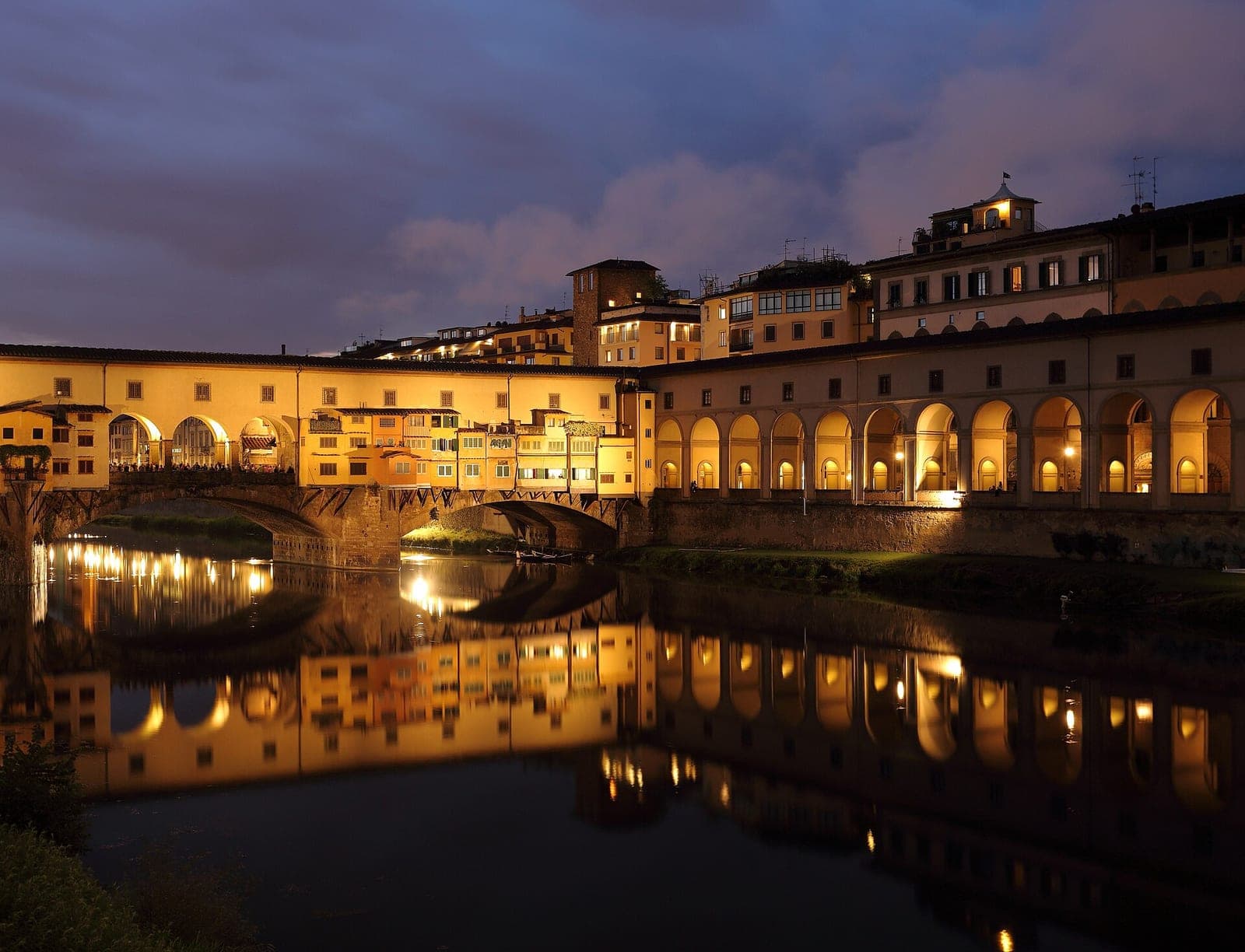
The Ponte Vecchio is Florence's medieval bridge of goldsmiths — a row of tiny jewellers' shops strung across the Arno, and perhaps the most romantic jewellery address in the world. What makes it more than a postcard is that the trade here is preserved by law: a 1593 Medici decree, still in force, means every shop on the bridge is, by rule, a goldsmith's or jeweller's.
The bridge itself dates to 1345 and once held butchers and fishmongers, who threw their waste into the river below. In 1565 Cosimo I de' Medici had the Vasari Corridor built straight over the shops, so the ruling family could cross the city unseen between the Palazzo Vecchio and the Pitti Palace. In 1593 his successor Ferdinando I evicted the other trades in favour of goldsmiths and silversmiths — partly to stop the smell rising to the corridor above — and that decree has defined the bridge ever since.
Today some shops are still owned by descendants of the families who arrived after 1593, and a few keep their old workshop windows, where you can watch goldsmiths working by hand. A bronze bust of Benvenuto Cellini, Florence's most celebrated goldsmith, stands at the centre of the bridge.
The Ponte Vecchio is the icon, but the living craft is in the Oltrarno just across the river, where Florentine goldsmithing continues in working ateliers — and the Medici silver collections sit nearby in the Museo degli Argenti at the Pitti Palace.
Planning to visit or buy in Ponte Vecchio Goldsmiths?
Getting there and when to go, what a fair price looks like, how to verify what you're buying, and how to spot a fake — the practical, no-nonsense guide.
Read the buyer's guideMakers & Houses
The Ponte Vecchio has been reserved to goldsmiths and silversmiths since Grand Duke Ferdinando I de' Medici's 1593 decree, a rule the bridge still keeps, making it the make-and-sell endpoint of Florentine goldsmithing.
The bridge is now largely a retail-sell endpoint of finished goldwork. Working benches on it are rare, with trade press describing Fratelli Piccini as the last operating goldsmith's workshop on the Ponte Vecchio.
- Recovered / recycled goldSource
- Ponte Vecchio, FlorenceMake
- Ponte Vecchio, FlorenceSell
Torrini
Torrini 1369Known for goldwork sealed with the house's 1369 signum, a half-clover with a spur
By record, the Torrini maker's mark, a signum of a half-clover with a spur, was registered in 1369 with the Blacksmiths' and Armourers' Guild of the Florentine Republic, documented in the State Archives of Florence, and is still struck to seal the firm's goldwork today.
Fratelli Piccini
Known for bespoke hand-made Florentine jewellery, worked by goldsmithing, engraving, enamelling and wax carving
Founded in 1903 and still family-run into its fourth generation, Fratelli Piccini keeps a working goldsmith's atelier on the top floor of the Ponte Vecchio, above the Arno, over its boutique at Ponte Vecchio 23R.
- Associazione Ponte Vecchio. The membership body of the bridge's goldsmiths, silversmiths and jewellers, custodian of the 1593 Medici decree.
- Consorzio Stile Orafo Fiorentino. A heritage-protection consortium for the Florentine goldsmithing style; its collective mark is in progress, not yet granted.
On the map
- The Ponte Vecchio (Florence's oldest bridge)
- The Vasari Corridor (1565)
- The Benvenuto Cellini monument
- The Oltrarno artisan workshops
- Museo degli Argenti (Pitti Palace)
In the district
Walk the district
Traveller notes
The bridge is the icon, but the living craft is in the Oltrarno across the river — and a 1593 Medici law means every shop on the Ponte Vecchio is, by decree, a jeweller's.
- Shops with old workshop windows — some goldsmiths still make pieces by hand in view of the street.
- The Benvenuto Cellini monument at the bridge's centre — Florence's most famous goldsmith.
- The Oltrarno, just across the river — the working artisan quarter behind the shopfronts.