Ramat Gan Diamond Exchange District
The world's largest diamond exchange — Israel's "Bursa," four towers in Ramat Gan through which a large share of the world's diamonds pass
Diamond exchange
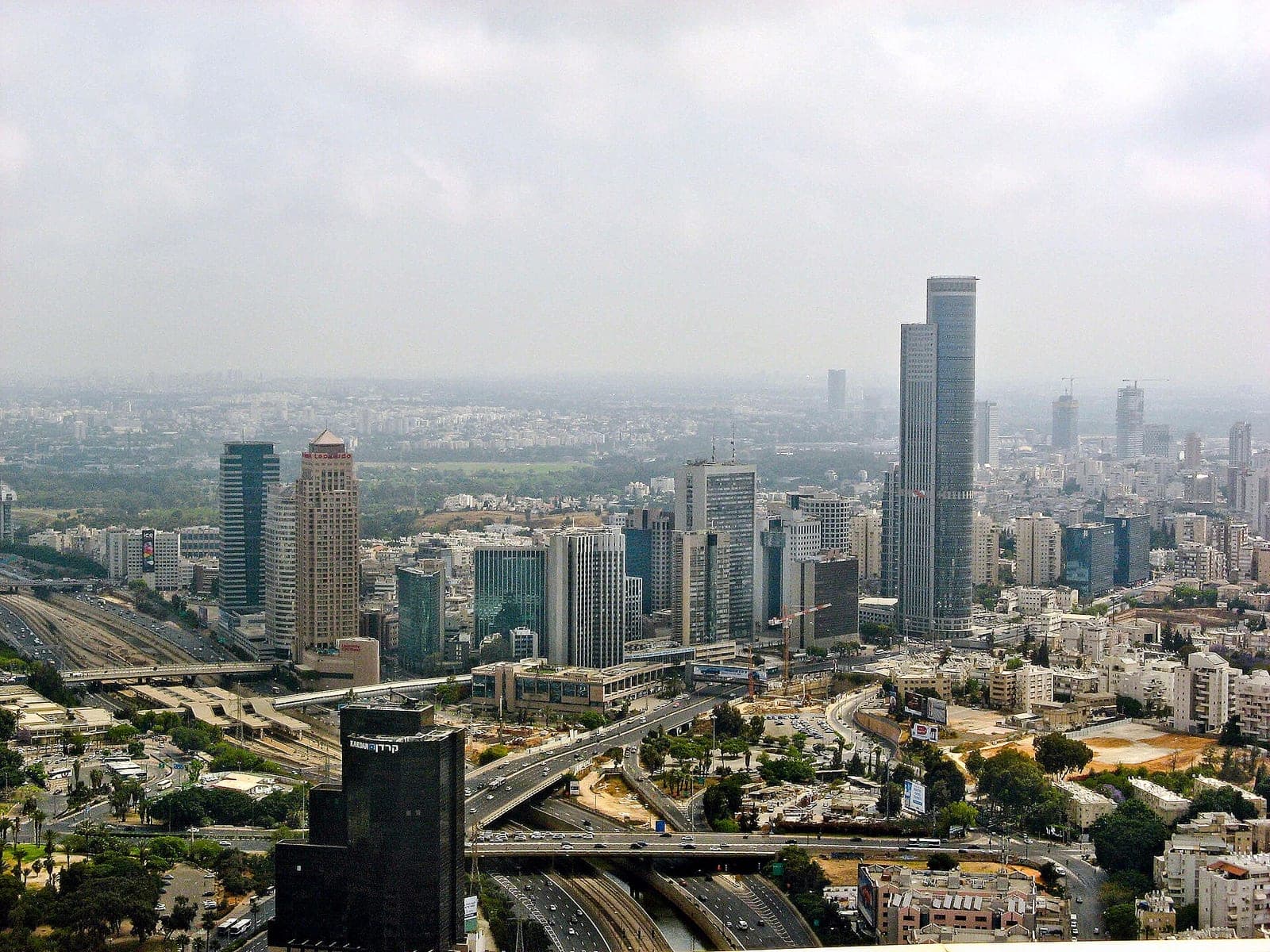
The Israel Diamond Exchange — "the Bursa" — is the world's largest diamond exchange and the centre of the country's diamond industry. It sits not in Tel Aviv proper but in Ramat Gan, immediately east of the city: a tightly knit cluster of four towers holding the world's largest diamond trading floor.
Israel's diamond story began with cutting. The first cutting plant opened in 1937, in Mandatory Palestine, run by diamantaires trained in Antwerp. The exchange itself was formally established in 1951 in rented Tel Aviv quarters; a decade later it bought land in Ramat Gan, and the first of its towers — the Shimson Tower — was inaugurated in 1968.
Today four interconnected towers, linked by bridges into a single complex of roughly a thousand offices, banks, and services, form the Diamond Exchange District. Israel exports on the order of $5 billion in diamonds a year, and a large share of the world's diamonds pass through these buildings at some stage.
It is the opposite of a bazaar: a modern, high-security institution where accredited members trade behind controlled access. This is where the global diamond trade is transacted, not browsed.
Planning to visit or buy in Ramat Gan Diamond Exchange District?
Getting there and when to go, what a fair price looks like, how to verify what you're buying, and how to spot a fake — the practical, no-nonsense guide.
Read the buyer's guideWorked here
A gemstone is rarely mined, cut, dealt and sold in the same place — those are four different trades. Here is Ramat Gan Diamond Exchange District's part in that journey: the stones it handles, and exactly what it does with each.
- Trade
- dealt and wholesaled here
- DiamondTrade
Israel mines no diamonds, yet the Ramat Gan exchange is the largest of its kind on earth, with roughly a third of the world's rough passing through its four towers. Its cutting industry was built by refugees: as Germany overran Belgium and Holland, diamantaires fled to Palestine with their polishing wheels — 4 plants in 1939 became 33 by 1942 — and Israel became a cutting superpower. But the bench work has since moved to India's Surat (which now polishes an estimated 90% of the world's stones), and Israel reinvented itself as a trading floor and a technology hub — its Sarine machines map rough, grade the 4Cs, and detect the lab-grown stones the trade now has to catch.
The diamond gemstone
Makers & Houses
Around the members-only trading floors of the Israel Diamond Exchange in Ramat Gan sits a ring of family houses, manufacturer-retailers and bespoke makers who sell the bourse's polished output directly to consumers.
Much of the district is wholesale and B2B, cutters and suppliers who never see a walk-in buyer, so the genuinely consumer-facing houses below are the exception, not the rule.
- African & global minesSource
- Ramat GanTrade
- Retail worldwideSell
Diamond Bourse
יהלומי הבורסהKnown for loose certified diamonds, engagement rings and bespoke jewellery, with in-house custom design
A consumer-facing house run by a third generation of jewellers who are members of the Israel Diamond Exchange and GIA graduate gemologists, selling first-hand certified diamonds directly from inside the bourse.
The Bursa for Jewelry
הבורסה לתכשיטיםKnown for natural-diamond rings, earrings, necklaces, bracelets and watches, domestically manufactured
A retail jewellery chain founded in 1975 and headquartered at the edge of the Exchange, which describes itself as the only Israeli network committed to natural diamonds only.
IDC (Israel Diamond Center)
Known for certified diamonds, gemstones and custom-made jewellery bought at the source
A family-run, IDE-member manufacturer-retailer with a consumer showroom inside the Exchange district, letting retail buyers purchase certified diamonds and commission jewellery at the source.
Jacobs Jewelry
ג'ייקובסKnown for personalised, one-of-a-kind gold and diamond pieces, including engagement rings, made to order
A bespoke jeweller whose workshop office sits inside the Exchange and whose consumer store faces the Tel Aviv seafront, a district-tied maker who designs personalised pieces to commission.
The Jewelry Gallery
Known for direct-to-consumer diamond jewellery from eight Israeli brands under one roof, plus repairs
The Exchange's purpose-built direct-to-consumer venue, several Israeli diamond brands selling to the public in one hall, a physical front door through which the bourse's makers reach retail buyers.
- Moti Israeli Diamonds · Named diamantaire, 40+-year Exchange member; own site currently offline
- DH Diamonds · Diamond manufacturer-retailer on Jabotinsky St; own site parked
- Gispan Diamonds · Family atelier of some forty years; own site currently offline
- Israel Diamond Exchange Ltd. (ISDE). Trade institution and private bourse operator, founded 1960. Members-only, not a consumer shop.
- Israel Diamond Institute (IDI). Trade body promoting the Israeli diamond industry.
- GIA (Israel lab). Grading laboratory; the Ramat Gan take-in lab has been scaled back.
- Sarine Technologies. B2B diamond-tech firm serving the trade.
- Steinmetz Diamonds. B2B diamond manufacturer and cutter, wholesale not consumer retail.
- Leo Schachter Diamonds. B2B diamond manufacturer with Israeli roots.
- Lili Diamonds. B2B diamond manufacturer and cutter.
- Historical: first Israeli diamond-cutting plant (1937). Industry origin, opened in Petah Tikva by Antwerp-trained cutters; the Exchange itself was founded 1960.
On the map
- The Diamond Exchange District ("the Bursa")
- Four interconnected towers, linked by bridges
- Shimson Tower (1968)
- The world's largest diamond trading floor