Hong Kong Jade & Gold Areas
Hong Kong's jade market — hundreds of covered stalls in Yau Ma Tei where the city's deep-rooted jade trade is bought and sold
Jade market
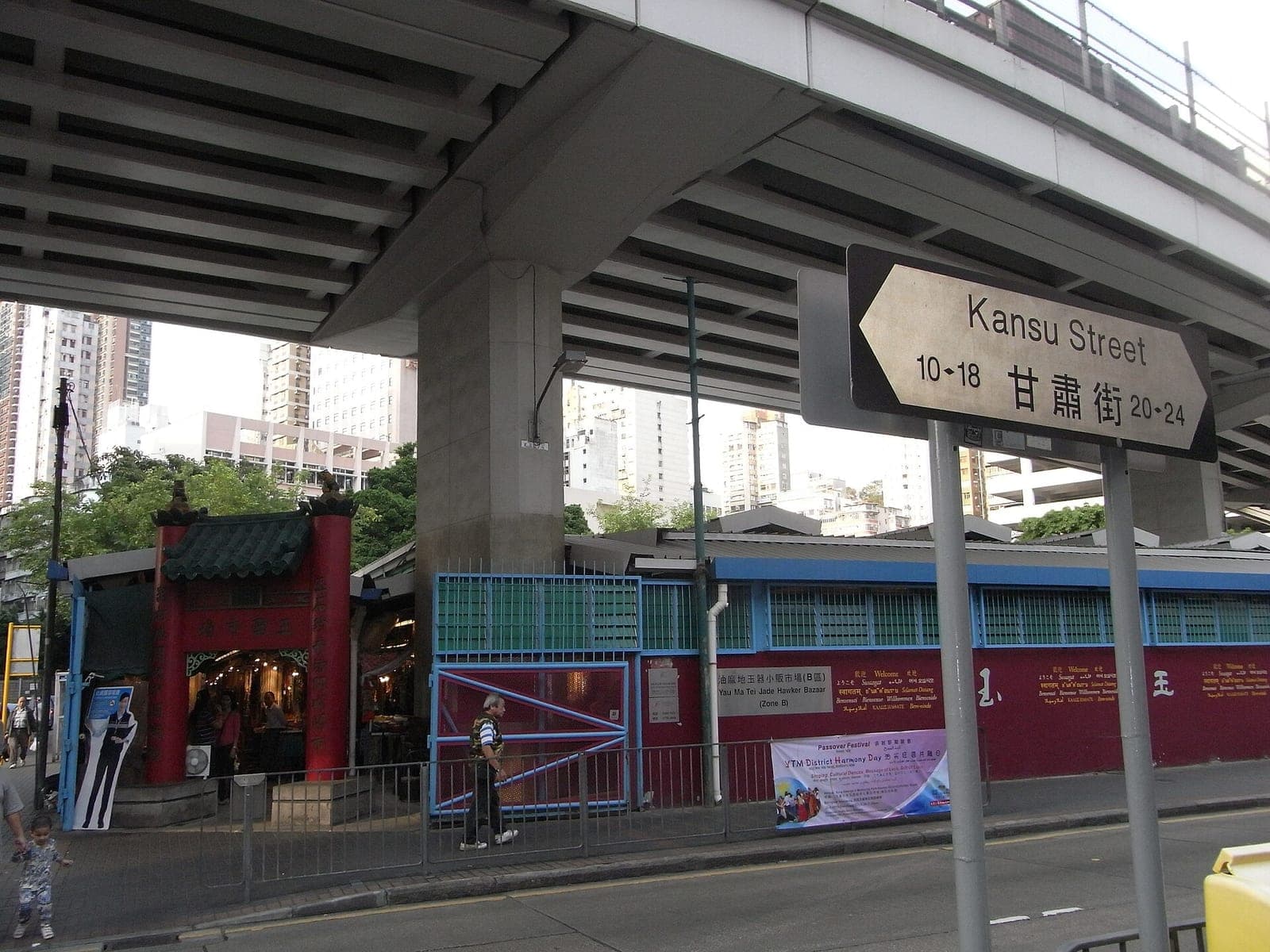
Hong Kong's Jade Market is a covered bazaar of around 400 stalls in Yau Ma Tei, Kowloon, dedicated to jade — jadeite above all — and backed by an adjacent "Jade Street." It is the city's window into the Chinese jade world, where a stone that carries deep cultural weight is bought, sold, and argued over.
The trade here began in the early 1950s, when jade dealers — many of them migrants from Guangzhou — set up street stalls in Kowloon. It boomed through the 1970s and 80s, helped along by a wave of global interest in jade after Nixon's 1972 visit to China. In 1984 the government moved the hawkers into the permanent covered market at the Kansu Street and Battery Street junction, organised into two zones of roughly 340 and 100 stalls.
Nearby, the stretch of Canton Road known as Jade Street holds higher-quality pieces and jade-identification services — which matter, because authenticity and quality vary enormously and treated or imitation jade is common. Alongside the jade you'll also find pearls, turquoise, amethyst, and amber.
It is a haggling, knowledge-rewards-you market rather than a fixed-price boutique — souvenirs at one end, serious jade at the other.
Planning to visit or buy in Hong Kong Jade & Gold Areas?
Getting there and when to go, what a fair price looks like, how to verify what you're buying, and how to spot a fake — the practical, no-nonsense guide.
Read the buyer's guideWorked here
A gemstone is rarely mined, cut, dealt and sold in the same place — those are four different trades. Here is Hong Kong Jade & Gold Areas's part in that journey: the stones it handles, and exactly what it does with each.
- Cut
- faceted, carved or finished here
- Trade
- dealt and wholesaled here
- Sell
- sold to the public here
- JadeiteCutTradeSell
The precious green jade — feicui, literally “kingfisher feathers” — is mined almost entirely in the hills of Myanmar's Kachin State, yet it is carved, dealt and revered here: a stone whose source and whose soul sit in different countries. It reached China only in the 1700s (for the millennia before, “jade” meant the paler nephrite). And it is never faceted, always carved — because jade is prized for toughness rather than hardness, and it isn't a crystal at all but a rock, an interlocking mass of countless grains. Buy by grade: only “Type A” is untreated; Type B is bleached and resin-filled, Type C dyed.
- NephriteCutTradeSell
This is the older, truer Chinese jade — carved since the Neolithic, before bronze, into the ritual discs and blades of the Hongshan and Liangzhu cultures. The prized “mutton-fat” white comes from Hotan in Xinjiang. It is a completely different rock from jadeite — an amphibole, not a pyroxene — and the two were only told apart by a French mineralogist in 1863; both were called “jade” simply because they look and behave alike. Nephrite is often named the toughest natural gem material on earth: you can't scratch it easily, and you almost can't break it.
Makers & Houses
Yau Ma Tei is Hong Kong's retail window on jadeite. Jade quarried at Hpakant in Myanmar reaches the city's covered jade hawker bazaar and the open-air Jade Street on Canton Road, where it is graded against a Type A, B and C disclosure standard formulated here and written into Hong Kong law.
- Hpakant, MyanmarSource
- Hong Kong, Jade StreetCut
- Hong Kong, Jade StreetSell
Mei Mei Wonbow
美美皇寶玉器公司Known for hand-worked jade jewellery, from raw stone to finished piece
A family jade jeweller on Jade Street, founded in 1975 by Hui Cheong-shin and now run into its second generation, that carries jade from raw stone to finished piece and runs occasional workshops teaching how to tell natural jade from treated. The Hong Kong Tourism Board documents it among West Kowloon's made-by-hand makers, and its craft is listed on Hong Kong's Intangible Cultural Heritage inventory.
Yim's Victor Jade
嚴氏永勝玉器行Known for jade jewellery from a ground-floor Jade Street storefront
A ground-floor storefront spanning a wide frontage on Jade Street, listed as a Hong Kong Jade Association member with its own retail website.
Hang Sun Jewellery
恒新珠寶行Known for jade jewellery from a ground-floor Jade Street storefront
A ground-floor storefront on Canton Road, listed as a member of both the Hong Kong Jade Association and the Hong Kong Jewellery and Jade Manufacturers Association.
- Yuk Oi Jade Jewelry · Four Seas Jade Centre, 532 Canton Road; Hong Kong Jade Association member
- Jade House · Jade Plaza, 513-531 Canton Road; Hong Kong Jade Association member
- Yau Ma Tei Jade Market. The covered jade hawker bazaar of about 400 stalls, relocated November 2020. The market building, not a single shop.
- Hong Kong Jade & Stone Laboratory (HKJSL). The grading laboratory that certifies Type A, B and C jadeite. A Verify institution.
- The Gemmological Association of Hong Kong (GAHK). Set the Fei Cui testing standard written into Hong Kong consumer-protection law.
- Hong Kong Jewellery & Jade Manufacturers Association. The sector's principal trade body, formed 1965.
On the map
- The Jade Market (Kansu St / Battery St)
- Jade Street (Canton Road)
- ~400 covered stalls (Zones A & B)
- Yau Ma Tei, Kowloon
In the district
Walk the district
Traveller notes
A genuine market where jade quality and price vary wildly — bring skepticism, expect to bargain, and use the identification services for anything serious.
- Jade Street (Canton Road) for higher-quality pieces and jade-identification services.
- ~400 stalls across two zones under the Kansu / Battery Street cover — haggling is expected.
- Treated and imitation jade are common — get a piece authenticated before paying serious money.