Idar‑Oberstein Gemstone Quarter
The world's gemstone-cutting town — for 500+ years the place where agate and coloured stones are cut, carved, and finished
Cutting & carving
Idar-Oberstein is the world's gemstone-cutting town. Not a mining town and not a retail strip — for more than five centuries this place in the Hunsrück hills of western Germany has been where rough agate and coloured stones are cut, carved, and brought to life.
The trade settled here for two reasons: the surrounding hills held agate, quartz, and jasper, and the Nahe river gave the power to work them. From the 15th century, cutters lay face-down on wooden benches and pressed stones to huge water-driven sandstone wheels; at its peak the town ran some 56 cutting mills.
When the local deposits ran out in the 1880s, Idar-Oberstein reinvented itself rather than fading: German emigrants found vast agate deposits in Brazil and shipped the rough back home — often as cheap ballast on returning ships — reviving the town and tying it permanently into the global stone trade. Water wheels later gave way to electric motors, and South African diamond grit sharpened the craft further.
Today it is a smaller but living cluster of family cutting houses (down from around 250 to roughly 150) that keep precision cutting and hardstone carving alive at the bespoke, one-of-a-kind end — with the German Gemstone Museum and the restored water-powered mills telling the story.
Planning to visit or buy in Idar‑Oberstein Gemstone Quarter?
Getting there and when to go, what a fair price looks like, how to verify what you're buying, and how to spot a fake — the practical, no-nonsense guide.
Read the buyer's guideWorked here
A gemstone is rarely mined, cut, dealt and sold in the same place — those are four different trades. Here is Idar‑Oberstein Gemstone Quarter's part in that journey: the stones it handles, and exactly what it does with each.
- Cut
- faceted, carved or finished here
- Treat
- heated, irradiated or enhanced here
- Trade
- dealt and wholesaled here
- AgateCutTreatTrade
This is where the West learned to cut stone. From the late 1400s, cutters lay face-down over water-powered sandstone wheels on the Nahe, grinding the agate dug from the surrounding hills. When the local seams ran out in the 1800s, emigrants from the town found the world's great agate deposit in Brazil (first shipment home, 1834) and shipped the rough back — reviving the trade and pulling Brazilian amethyst and tourmaline along the same route. One legacy sits in nearly every jewellery box: solid black onyx barely exists in nature — Idar-Oberstein invented it in the 1820s, soaking pale agate in sugar then sulphuric acid to carbonise the bands black.
- TourmalineCutTreatTrade
Idar-Oberstein lost the world's volume cutting to Asia — and survived by going up, not cheap. Today it is a small cluster of elite bespoke lapidaries working tourmaline, aquamarine, tanzanite, opal and spinel from every continent, and new gem discoveries are still sent here specifically for its accumulated skill in cutting and treating stone. It is the birthplace of Bernd Münsteiner's sculptural “Fantasy Cut” (1960s), the most influential idea in creative faceting in a century — proof the town kept the hands after it lost the mines.
The tourmaline gemstone
Makers & Houses
Idar-Oberstein is Germany's coloured-stone cutting town, plugged into the global trade through its own bourse and fed for two centuries by a Brazil-to-Idar rough-stone pipeline, seeded when Idar-Oberstein emigrants reached Brazil in 1822 and still worked today by houses that mine their own rough and cut it in the district.
Much of the town's work is discreet, trade-only cutting and treating supplied into other names' finished goods. The district is felt in the stones more than in the shop signs.
- Brazil / Africa (own mines)Source
- Idar-ObersteinTreat
- Idar-ObersteinCut
Atelier Munsteiner
Bernd MunsteinerKnown for the Fantasy Cut, freeform negative carving into the back of a gemstone
Bernd Munsteiner, trained in the Idar-Oberstein lapidary tradition, is credited by GIA and the trade press as the originator of the fantasy cut, freeform negative carving into the back of a gemstone. He founded his atelier in 1973 above Idar-Oberstein; the workshop continues into the fifth generation of Munsteiner cutters.
Paul Wild OHG
Known for vertically integrated coloured stones, Paraíba tourmaline and aquamarine cut from its own rough
A Kirschweiler house whose gemstone-cutting firm was established in 1927. It operates its own coloured-gemstone mines in Africa and Brazil and cuts the rough in Germany, closely associated with Paraíba tourmaline and fine aquamarine.
Constantin Wild
Known for fine coloured gemstones sourced worldwide and cut in Idar-Oberstein
A coloured-stone house founded in Idar-Oberstein in 1847, led today by a fourth-generation gem dealer, one of the district's longest-running family firms, marking 175 years in the trade in 2022.
Groh + Ripp
Known for precision-cut coloured gemstones, including dials and components supplied to Swiss watchmaking
An Idar-Oberstein cutting-and-dealing firm founded in 1953. Its in-house cutting is known in the trade for precision coloured stones, including components supplied to high-end Swiss watchmaking.
Emil Weis Opals
Known for opals sourced, cut and traded from the Idar-Oberstein district
An opal specialist founded in 1905 in Kirschweiler, now in its third and fourth generations, representing the district's move beyond agate into specialist coloured and organic stones.
- Diamant- und Edelsteinbörse Idar-Oberstein e.V.. The world's first combined exchange to trade both diamonds and coloured gemstones, opened 1974. A bourse, not a shop.
- DSEF German Gem Lab. The German Gemmological Association's lab, identifying natural versus treated stones and determining origin. A Verify institution.
On the map
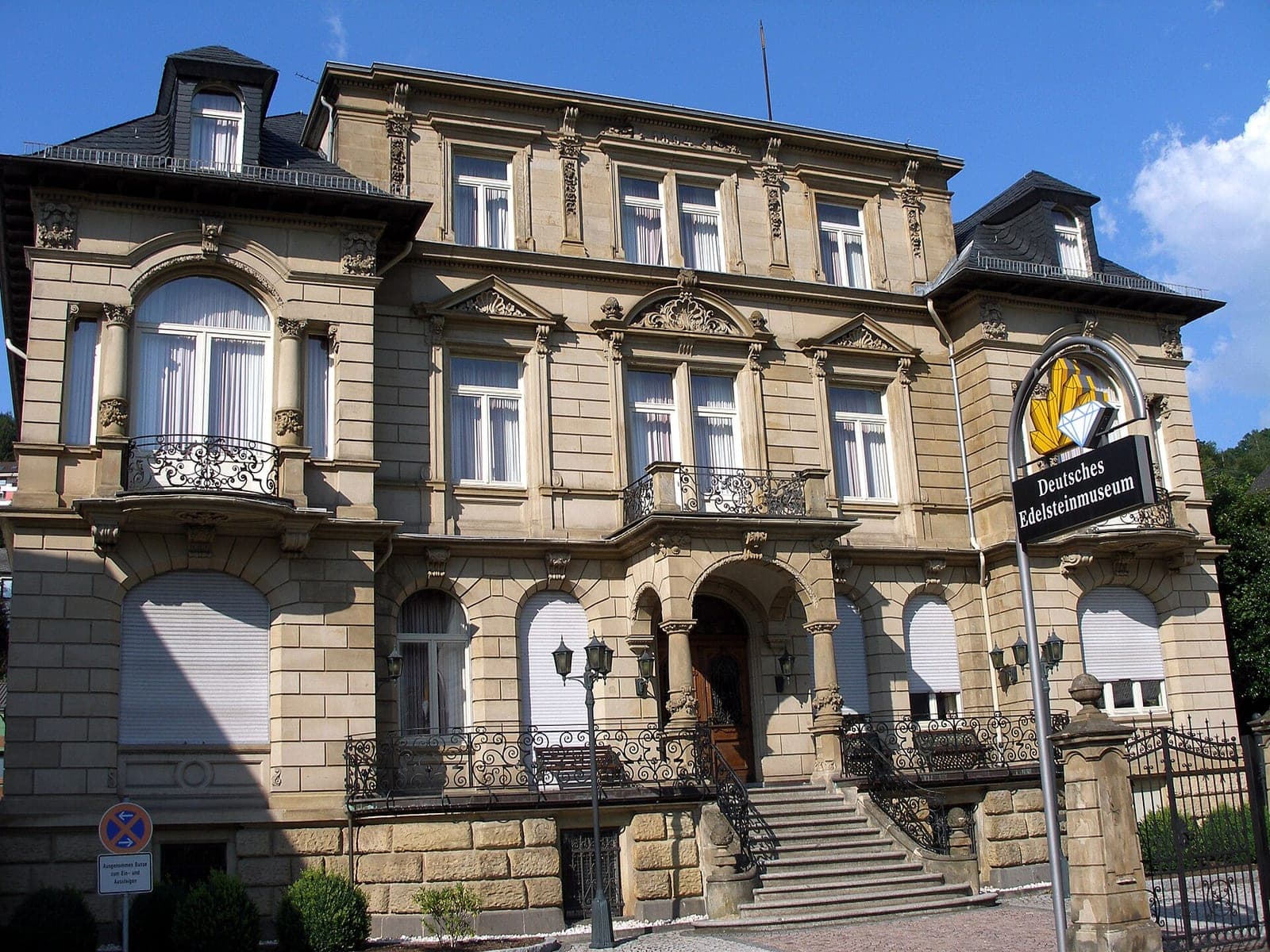
- Deutsches Edelsteinmuseum (German Gemstone Museum)
- Museum Idar-Oberstein
- The Weiherschleife grinding mill
- The Nahe-valley cutting workshops
In the district
Walk the district
Traveller notes
Idar-Oberstein wears its trade openly — you can trace how a rough stone becomes a gem, from water-powered grinding mills to a museum of thousands of cut and carved stones.
- Deutsches Edelsteinmuseum (German Gemstone Museum) — thousands of cut and carved stones across several floors.
- The Weiherschleife — a preserved water-powered grinding mill, working again as a museum since 1997.
- Museum Idar-Oberstein — the town and trade's own story.