Johari Bazaar & MI Road
The jewellers' market of Jaipur's Pink City — coloured-stone capital and home of kundan, jadau, and meenakari craft
Gem cutting & craft
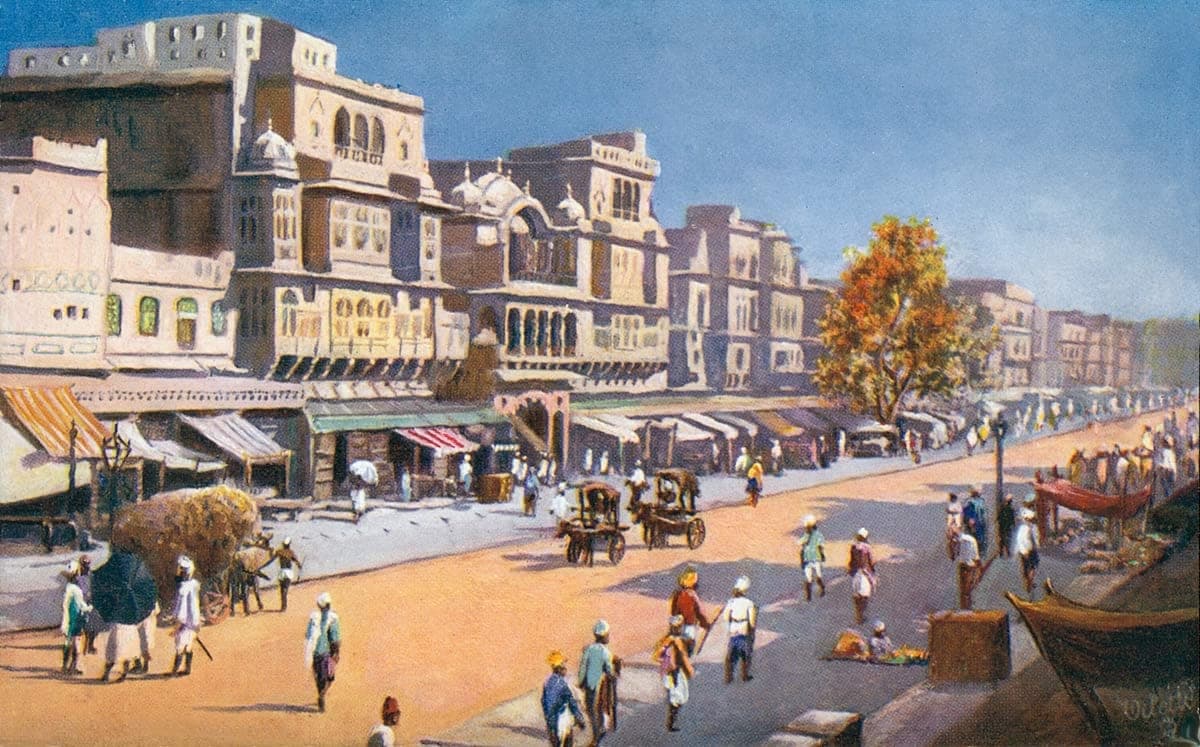
Johari Bazaar — literally the "Jewellers' Market" — is the jewellery heart of Jaipur's walled Pink City, and Jaipur is widely called the Gemstone Capital of the World. Its signature is coloured stones, emeralds above all, and a trio of traditional crafts found together almost nowhere else.
The market is as old as the city. When Maharaja Sawai Jai Singh II founded Jaipur in 1727 — laying it out to Vastu Shastra principles — he set aside this street for jewellers and gem merchants and invited skilled craftsmen from across India to settle. Many of the shops are still family businesses passed down for generations, having served both the royal court and ordinary people.
Three techniques define Jaipur's craft: kundan, in which gemstones are set into a framework of pure gold foil; jadau, where uncut diamonds and stones are embedded directly into gold without prongs, the labour-intensive heart of North-Indian bridal jewellery; and meenakari, the vivid enamelling often worked into the reverse of the same pieces. Around all of it, Jaipur remains one of the world's great centres for cutting and trading coloured gemstones.
It is, unmistakably, a living bazaar — pink-arched and photogenic, gold and stones sold among the textiles and sweets of the old city — rather than a luxury arcade.
Planning to visit or buy in Johari Bazaar & MI Road?
Getting there and when to go, what a fair price looks like, how to verify what you're buying, and how to spot a fake — the practical, no-nonsense guide.
Read the buyer's guideWorked here
A gemstone is rarely mined, cut, dealt and sold in the same place — those are four different trades. Here is Johari Bazaar & MI Road's part in that journey: the stones it handles, and exactly what it does with each.
- Source
- mined at or near here
- Cut
- faceted, carved or finished here
- Trade
- dealt and wholesaled here
- EmeraldCutTrade
Johari Bazaar means, literally, “market of gem dealers,” and Jaipur cuts more emerald than any city on earth — yet India has essentially no emerald mines. The rough is imported (roughly four-fifths of Zambia's emerald is shipped here, alongside Brazilian and Colombian stone) and faceted by cutters whose craft the city has drawn since its founding in 1727. The lesson most buyers miss: a “Colombian” or “Zambian” emerald in a Western case was, more likely than not, given its shape in Jaipur — where a stone is cut rarely matches where it came out of the ground.
The emerald gemstone - TanzaniteCutTrade
Tanzanite is found in exactly one place on earth — a few square kilometres near Kilimanjaro — yet much of it is cut four thousand miles away, in Jaipur. When Tanzania restricted the export of rough tanzanite in 2010 to force more cutting at home, the ripple reached these workshops overnight: one source-country's policy reshaped a Rajasthan cutting district. Source and facet, once again, in different countries.
The tanzanite gemstone - GarnetSourceCutTrade
Garnet is Jaipur's honest exception — the one stone that is genuinely Indian. Rajasthan and Tamil Nadu are among the world's largest garnet producers, and Rajasthan's gem almandine has fed the local benches for generations, so here a stone can truly be mined, cut and dealt in the same state. The caveat worth knowing: most Indian garnet is dug as an industrial abrasive for sandblasting, not for jewellery — the gem-grade share is the small part.
The garnet gemstone
Makers & Houses
Jaipur is a leading emerald cutting and trading centre. Rough emeralds mined at Kagem in Zambia, and also Brazil, are cut and traded in the walled city's Johari Bazaar, India's oldest jewellery-trade quarter, before reaching collectors worldwide, and the same quarter carries the court-jeweller houses and the kundan-and-meenakari craft the city is known for.
- Kagem mine, ZambiaSource
- Jaipur, Johari BazaarCut
- Collectors & connoisseurs, internationalSell
Gem Palace
Kasliwal family · कसलीवालKnown for high jewellery and court-jeweller commissions
One of India's oldest jewellery houses, at its Mirza Ismail Road premises since 1852, and court jewellers to Jaipur's rulers. Its own material cites a 170-year legacy; stated conservatively, over 160 years.
Amrapali Jewels
Known for tribal, silver and uncut-gemstone jewellery
Founded 1978 in Jaipur, designing, producing and distributing tribal, fine and uncut-gemstone jewellery. Co-founder Rajesh Ajmera's father was a successful emerald dealer in Jaipur, the clause carrying the coloured-stone district tie.
Birdhichand Ghanshyamdas
Known for kundan and polki bridal jewellery, coloured gemstones and enamel or meenakari work
A Johari Bazaar jewellery house whose flagship store opened in 1930, known for kundan and polki bridal jewellery, coloured gemstones and enamel work; it later expanded to Mirza Ismail Road (2006) and New Delhi (2018).
Sunita Shekhawat
Known for meenakari high jewellery, the district's kundan-and-meenakari heritage craft
Described as the modern Meenakar, she has revived Jaipur meenakari since 1996 and in 2024 opened the Museum of Meenakari Heritage in Jaipur, described as India's first institution dedicated to the craft.
Tank Fine Gems
Dharmendra TankKnown for fine emerald cutting
Dharmendra Tank, of the Tank cutting family, cuts emeralds in Jaipur, a city GIA calls a leading emerald cutting and trading centre, working rough sourced primarily from Zambia but also from Brazil.
- Gem Testing Laboratory (GTL), Jaipur. One of India's oldest gemmological laboratories, set up 1972 by the GJEPC. A Verify institution, not a business.
- The Jewellers Association, Jaipur. The apex trade body of Jaipur's jewellers, formed 1927. A trade institution, not a shop.
On the map
- Johari Bazaar ("Jewellers' Market")
- The walled Pink City (planned 1727)
- Hawa Mahal (overlooking the bazaar)
In the district
Walk the district
Traveller notes
Johari Bazaar is a working market, not a mall — best for coloured stones and the traditional kundan / jadau / meenakari craft, amid the pink arches of the old city.
- Look for kundan, jadau, and meenakari work — Jaipur's signature techniques, often combined in a single bridal piece.
- Jaipur is a coloured-stone capital (emeralds especially) — ask for certification on any loose gem.
- The Hawa Mahal overlooks the bazaar's north end — an easy landmark to orient by.